

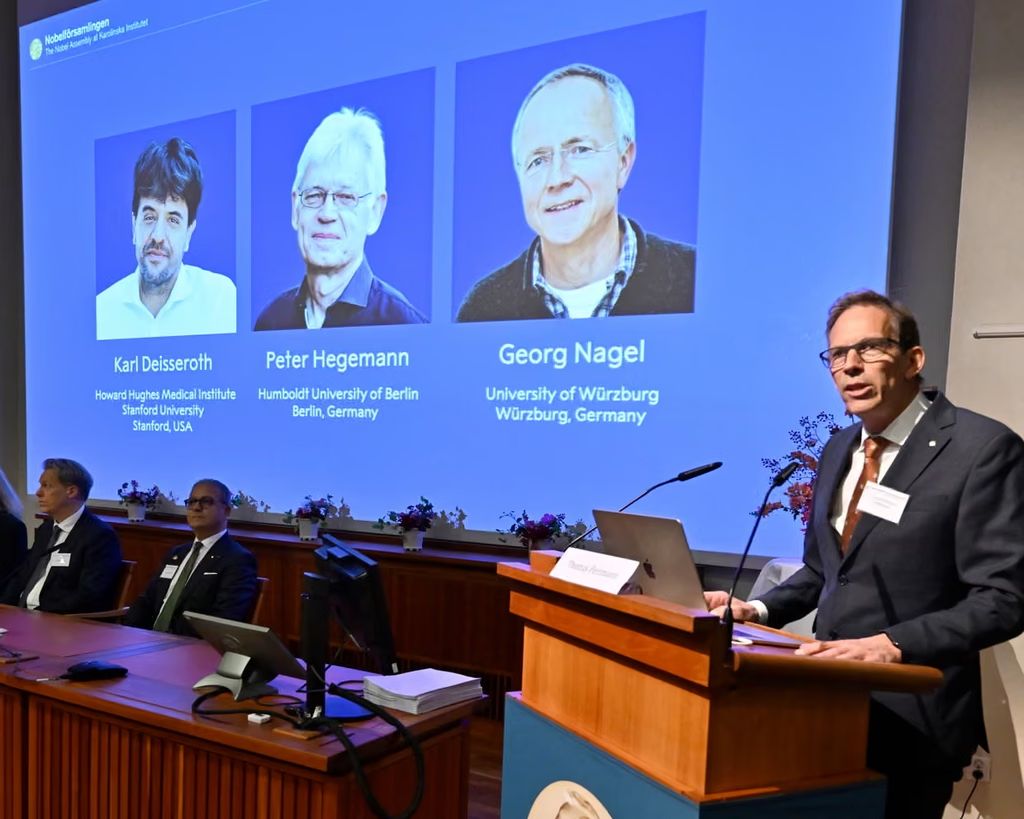
The Nobel Prize in Medicine 2026 has been awarded to Karl Deisseroth (USA), Peter Hegemann (Germany) and Georg Nagel (Germany) for discovering optogenetics. This is a method that lets scientists switch individual brain cells on and off using nothing but light.
It sounds like science fiction, but it is real, and it started with a tiny green alga swimming in a pond. This article explains everything step by step in simple words, so you don’t need any science background.
Who Won the Nobel Prize in Medicine 2026?
The Nobel Assembly at the Karolinska Institutet in Stockholm, Sweden, announced the winners on Monday, 5 October 2026. The official name of the prize is the Nobel Prize in Physiology or Medicine. The three winners are:
- Karl Deisseroth, Stanford University, USA
- Peter Hegemann, Humboldt University of Berlin, Germany
- Georg Nagel, University of Würzburg, Germany
They won “for their discoveries concerning light-gated ion channels and optogenetics.” In simple words, they found a way to control brain cells with light.
The prize is 12 million Swedish kronor (about $1.2 million), shared equally among the three.
This award had been expected for years. Nature reported that optogenetics had been on many scientists’ shortlists for a long time.
Meet the Winners
Peter Hegemann (Germany)
- Born 11 December 1954 in Münster, Germany
- A biophysicist who studies how living things sense light
- In the 1990s, he studied how a tiny alga reacts to light, including reactions that happen in about half a millisecond
- Now a professor at Humboldt University of Berlin
Georg Nagel (Germany)
- Born 24 August 1953
- Studied biology and biophysics
- A professor at the University of Würzburg
- Worked with Hegemann and a colleague, Ernst Bamberg, at the Max Planck Institute of Biophysics in Frankfurt, where the prize-winning discoveries were made
- A colleague who has worked with all three winners described Nagel as humble and modest
Karl Deisseroth (USA)
- Born 18 November 1971 in Boston, Massachusetts
- Earned both his PhD and his medical degree (MD) at Stanford University
- He first planned to become a neurosurgeon, but after meeting patients suffering from conditions like depression, he switched to psychiatry
- A professor at Stanford and an investigator at the Howard Hughes Medical Institute
- He coined the name “optogenetics” in 2006
When he heard the news, Deisseroth was almost asleep. He said the phone call came late at night and that he had trouble forming words for about 30 seconds.
Hegemann and Nagel made the first big discovery. Deisseroth then turned it into a tool for the brain.
What Is Optogenetics? Start With a Light Switch
Your brain has about 86 billion nerve cells, called neurons. They talk to each other using tiny electrical signals. Every thought, memory, feeling and movement comes from these signals.
For a long time, scientists faced a big problem: how do you find out what each type of cell actually does?
The old tools were too rough
- Electrodes (tiny electric wires) switch on every cell nearby, not just the ones you want.
- Medicines work slowly and spread through the whole brain.
It was like trying to find out which switch controls which lamp in a huge house by flipping the main power. Everything goes on or off together.
Optogenetics is a remote control
Optogenetics gives scientists a way to control only chosen cells, with light, in a fraction of a second. The name comes from two parts:
- Opto means light
- Genetics means using genes
The idea has three steps:
- Give a chosen type of brain cell a gene that makes it sensitive to light.
- Shine a light on the brain.
- Only those cells switch on (or off), within about a thousandth of a second.
Now scientists can ask clear questions. For example: “If I switch on only these cells, does the animal feel afraid? Does it move? Does it remember something?” This lets them see what a cell really causes, instead of just guessing.
The Story Behind the Discovery
A dream from the 1970s
In 1979, the famous scientist Francis Crick (who helped discover the shape of DNA) wrote that neuroscience needed a way to control one type of brain cell at a time. He even guessed that light might be the answer. For decades, nobody knew how to do it.
Step 1: A tiny alga that loves light
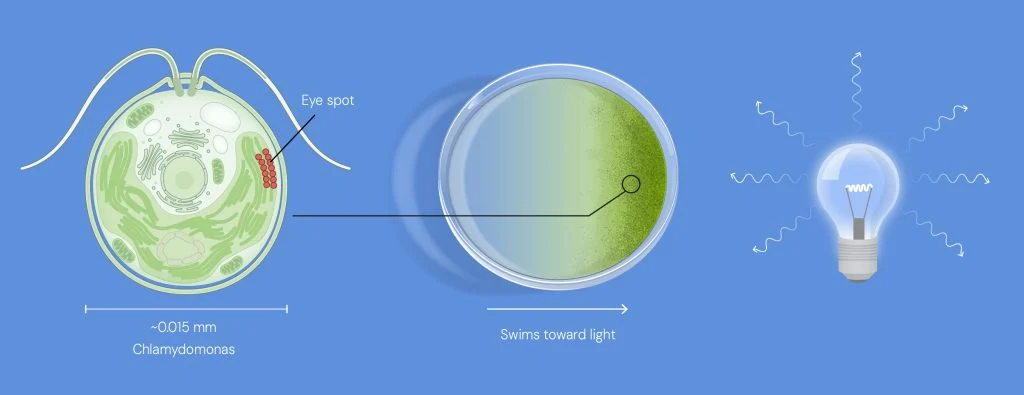
The answer came from a place nobody expected: a pond. Chlamydomonas reinhardtii is a tiny green alga. It can swim toward light, just like a sunflower turns toward the sun. Scientists knew it had a light-sensing spot, but they didn’t fully understand how it worked.
Peter Hegemann spent years studying how this alga reacts to light. He wanted to understand the exact molecule behind it.
Step 2: Finding the molecule (2002 and 2003)
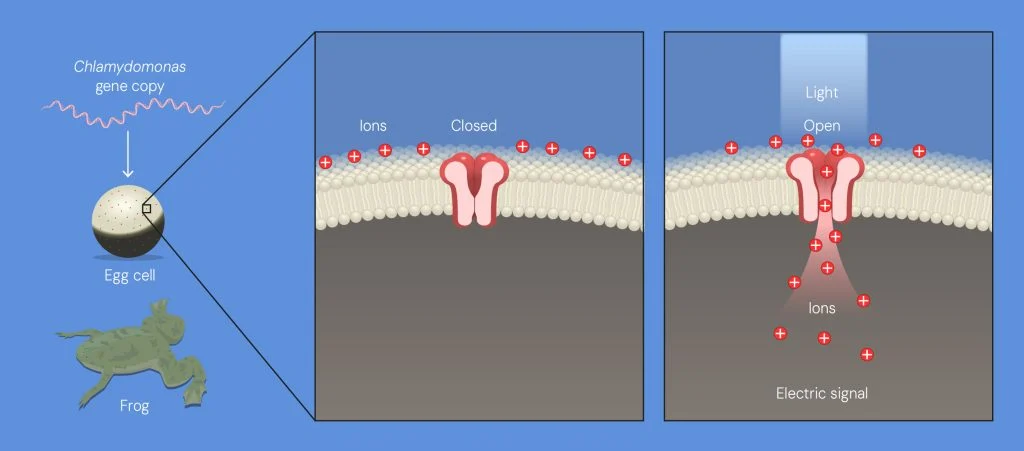
Hegemann teamed up with Georg Nagel and Ernst Bamberg. Nagel took the alga’s genes and put them into frog eggs, which are large, easy-to-study cells. Then they shone light on them.
Something amazing happened: the frog egg cells responded to light. The team had found a protein that opens a tiny gate in the cell wall when it is hit by blue light. They named it channelrhodopsin.
- Channel means a gate or tunnel in the cell wall
- Rhodopsin means a light-sensing protein
They published their findings in 2002 (channelrhodopsin-1) and 2003 (channelrhodopsin-2). The Nobel Committee said Hegemann and Nagel realised exactly what they had found.
Step 3: Putting it into brain cells (2005)
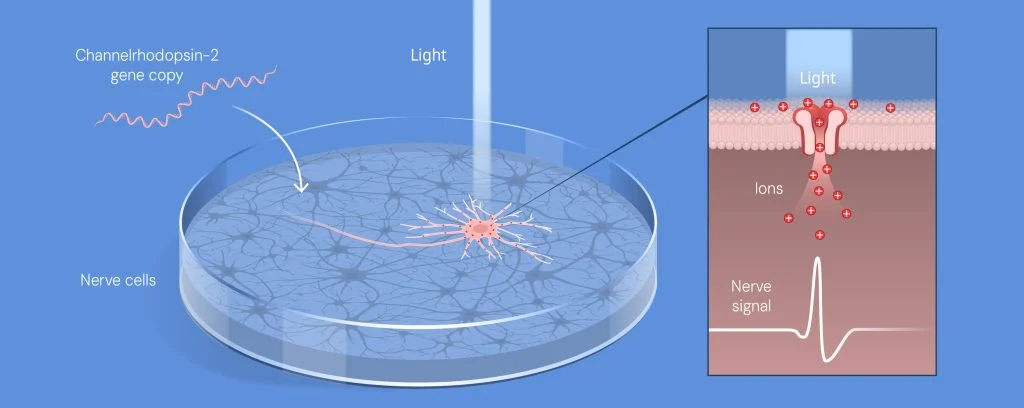
Karl Deisseroth, who at the time was a young scientist and psychiatrist at Stanford, understood how important this could be for the brain. His team, working with Nagel and others including Ed Boyden, Feng Zhang and Ernst Bamberg, put the algal gene into mammal neurons.
When they shone light on the cells, the neurons fired. The response was instant and exact, within a millisecond.
The Nobel Committee notes that a few years later he made it work in the brains of living mice, which showed that optogenetics could control behavior in a live animal.
Step 4: The name (2006)
In 2006, the new method was named optogenetics.
A fair note: many scientists helped build this field. Nobel prizes can go to a maximum of three people, so others who contributed were not named by the committee.
How the Discovery Works, Step by Step
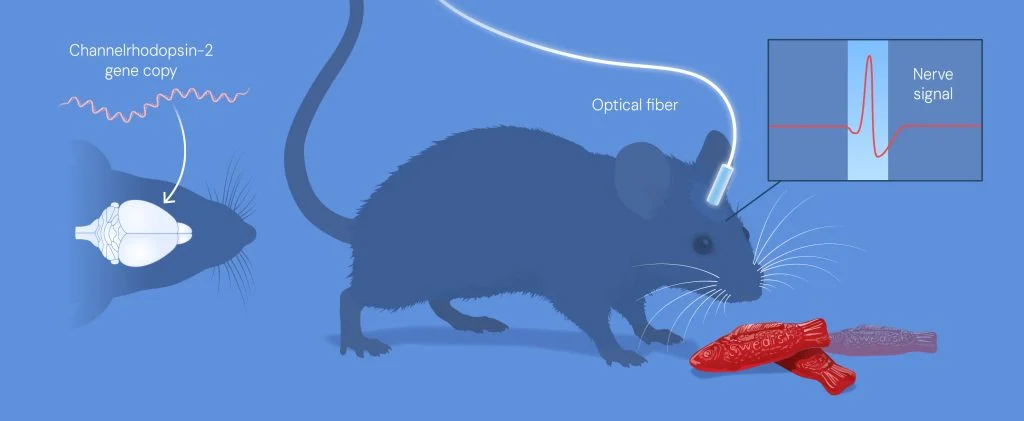
Here is the process in simple words:
- Pick the cells. Scientists choose a certain type of neuron in the brain.
- Deliver the gene. They use a harmless virus as a “delivery truck” to carry the gene for the light-sensing protein into those cells only.
- The cells make the protein. The protein sits in the cell wall like a tiny gate.
- Shine light. In animal experiments, a thin glass fiber (like a hair-thin cable) brings light into the brain.
- The gate opens. Charged particles flow in, and the neuron fires.
- Watch what happens. Scientists see how the animal’s behavior or the brain’s activity changes.
By using different proteins, scientists can also switch cells off with other colors of light.
Since 2005, researchers have built a whole toolkit of these proteins. Some react faster, some respond to different colors, and some work better deep inside the body.
What Optogenetics Has Already Done
This is one of the most widely used tools in modern brain research. Here is what it has helped scientists do:
Mapping memory, feelings and behavior
The Nobel Committee said optogenetics has revealed which brain circuits control specific memories, feelings and behaviors that matter in brain and mental health conditions. Scientists have used it to study:
- Fear and anxiety
- Memory
- Addiction
- Sleep and movement
Understanding brain diseases
It has helped researchers better understand depression, schizophrenia, Parkinson’s disease and Alzheimer’s disease. Studying what goes wrong in the circuits is the first step to fixing it.
Studying the whole body, not just the brain
Optogenetics is not limited to the brain. The first use in a whole animal was in a tiny worm called C. elegans in 2005. Scientists are also using light-controlled proteins to study other cells in the body.
Reaching deep inside the brain without surgery
A 2026 paper in Nature Chemistry reported that a protein called ChRmine could be used to control deep brain regions without surgery inside the skull. This kind of research aims to make the technology easier and safer to use.
How It May Help Patients
Optogenetics is first of all a research tool. The treatments are still developing, but real progress has begun.
1. Restoring vision (the most advanced use)
In retinitis pigmentosa, the eye’s light-sensing cells (the rods and cones) slowly die, which leads to blindness. In clinical trials, researchers insert a light-sensitive protein into other cells of the retina so they can partly do the job of the lost cells.
According to the Nobel Committee, when a channelrhodopsin-like protein was inserted into the retina of a blind person, the person regained some vision. In reported cases, patients also wore special camera goggles that turn the scene into light the new proteins can detect.
Important: this restores some sight, not perfect vision, and it is still being tested in trials.
2. Better hearing devices
The Nobel Committee says there are hopes that optogenetics could improve cochlear implants, which help people with severe hearing loss. Light can be more precise than electricity, which may lead to clearer sound.
3. New ideas for brain and mental health treatments
By showing exactly which cells and circuits are involved in depression, Parkinson’s disease, epilepsy and other conditions, optogenetics shows doctors where to aim treatments. Even if the treatment doesn’t use light, the knowledge helps design better drugs and brain stimulation methods.
4. Cable-free devices
Researchers are moving toward wireless and cable-free devices that deliver light without wires going into the head. This could make future treatments safer.
This article is for education only and isn’t medical advice. Please talk to your doctor about your own health.
What Optogenetics Can’t Do Yet
Here is the honest picture, because it helps you understand what is real:
- It needs gene delivery. Cells must receive a new gene, which is a serious step. That is why human use is limited to serious conditions like blindness for now.
- Light must reach the cells. In the eye, light enters naturally. In the brain, it needs a fiber or implant, or new proteins that react to light passing through the skull.
- Mostly animal research so far. It is used mainly in mice, rats, worms and flies. Most brain uses in humans are not yet approved treatments.
- Brains are complicated. Human brains are much larger and more complex than a mouse’s, so results don’t always transfer directly.
How It Is Changing Science and the World
From “what is connected” to “what causes what”
Before optogenetics, scientists could mostly watch the brain. Now they can test cause and effect. This is a major step because it turns guesses into proof. Per Svenningsson, chair of the Nobel Committee, said it allows mapping the brain “in a way that we could once only dream of.”
A tool shared with the world
Deisseroth’s team shared its genes and tools with thousands of labs around the world. A neuroscientist at the Allen Institute said this commitment to sharing was as important as the discovery. This made optogenetics spread fast, and labs everywhere now use it.
A bridge between engineering and medicine
Deisseroth has described the field as a mix of engineering and medicine. It brings together genetics, light technology, electronics and brain science, and it inspires new methods in all of these.
Coming next
Experts expect progress in:
- Safer, easier ways to deliver light and genes
- More treatments tested in people, starting with the eye
- Better understanding of mental health conditions
- New tools for other organs of the body
Quick Facts
| Fact | Detail |
|---|---|
| Announced | Monday, 5 October 2026, Karolinska Institutet, Stockholm |
| Winners | Karl Deisseroth, Peter Hegemann, Georg Nagel |
| Prize money | 12 million SEK (about $1.2 million), shared equally |
| Prize reason | “Discoveries concerning light-gated ion channels and optogenetics” |
| Key protein | Channelrhodopsin (found in a green alga) |
| Channelrhodopsin discovered | 2002 and 2003 |
| First use in mammal neurons | 2005 |
| Name “optogenetics” created | 2006 |
| First clinical use | Restoring some vision in retinitis pigmentosa (trials) |
| Earlier honors | Deisseroth and Hegemann shared the Harvey Prize (2016) and the Warren Alpert Prize (2019) |
Frequently Asked Questions
Who won the Nobel Prize in Medicine 2026?
Karl Deisseroth, Peter Hegemann and Georg Nagel.
What is optogenetics in simple words?
It is a method that uses light and genes to switch specific brain cells on or off, like a remote control for cells.
What is channelrhodopsin?
It is a light-sensitive protein, first found in a green alga, that opens a tiny gate in a cell when blue light hits it.
Who discovered optogenetics?
Peter Hegemann and Georg Nagel found the protein, and Karl Deisseroth developed the method for using it in brain cells. Many other scientists helped build the field.
Is optogenetics used on humans?
Yes, in early clinical trials. The most advanced is for restoring some vision in people blinded by retinitis pigmentosa. Most other uses are still in animal research.
Can optogenetics cure depression or Parkinson’s disease?
Not yet. It has helped scientists understand these conditions, which may lead to better treatments. It isn’t an approved treatment for them today.
Is it safe?
It is still being studied. It needs gene delivery, so it is only tested in people where the potential benefit is high, like blindness.
Why did it take so long to get the Nobel Prize?
Optogenetics was on many shortlists for years. Nobel committees often wait to see the full impact of a discovery.
Final Thoughts
A tiny pond alga that swims toward the light helped solve one of science’s hardest problems: how to switch brain cells on and off. Hegemann and Nagel found the light-sensing protein, and Deisseroth turned it into a tool that changed neuroscience. Today it is helping us understand memory, fear, addiction and disease, and it has even helped some blind patients see again.
What do you think about this year’s Nobel Prize in Medicine? Share your thoughts in the comments below!
Also read: Nobel Prize in Chemistry 2026: Kagan & Soai Explained Simply
References
- Nobel Prize Outreach. “Press release: Nobel Prize in Physiology or Medicine 2026,” 5 Oct 2026. https://www.nobelprize.org/prizes/medicine/2026/press-release/
- Nobel Prize Outreach. “Popular information: Nobel Prize in Physiology or Medicine 2026.” https://www.nobelprize.org/prizes/medicine/2026/popular-information/
- Nobel Committee for Physiology or Medicine. “The 2026 Nobel Prize in Physiology or Medicine: Popular Science Background.” https://www.nobelprize.org/uploads/2026/10/popular-medicineprize2026.pdf
- Nobel Committee for Physiology or Medicine. “Scientific Background 2026: Optogenetics. Discovery of a neuronal switch.” https://www.nobelprize.org/uploads/2026/10/advanced-medicineprize2026.pdf
- Naddaf, M. & Callaway, E. “Medicine Nobel awarded for brain ‘switch’ that controls neurons with light.” Nature, 5 Oct 2026. https://www.nature.com/articles/d41586-026-03091-2
- Chemical & Engineering News (ACS). “Optogenetics researchers win Nobel Prize in Physiology or Medicine,” 5 Oct 2026. https://cen.acs.org/people/nobel-prize/nobel-2026-physiology-medicine/104/web/2026/10
- STAT News. “Deisseroth, Hegemann, Nagel awarded 2026 Nobel Prize in Medicine,” 5 Oct 2026. https://www.statnews.com/2026/10/05/nobel-prize-medicine-2026-winner-deisseroth-hegemann-nagel/
- Physics World. “Inventors of optogenetics win Nobel Prize in Physiology or Medicine.” https://physicsworld.com/a/inventors-of-optogenetics-win-nobel-prize-in-physiology-or-medicine/
- CBC News. “Nobel Prize in Medicine awarded to scientists who pioneered work in optogenetics.” https://www.cbc.ca/news/world/nobel-prize-sweden-medicine-physiology-9.7366536
Original Research Papers
- Nagel, G., et al. (2002). Channelrhodopsin-1: a light-gated proton channel in green algae. Science, 296, 2395-2398.
- Nagel, G., et al. (2003). Channelrhodopsin-2, a directly light-gated cation-selective membrane channel. Proceedings of the National Academy of Sciences (PNAS), 100, 13940-13945.
- Boyden, E. S., Zhang, F., Bamberg, E., Nagel, G., & Deisseroth, K. (2005). Millisecond-timescale, genetically targeted optical control of neural activity. Nature Neuroscience, 8, 1263-1268.