

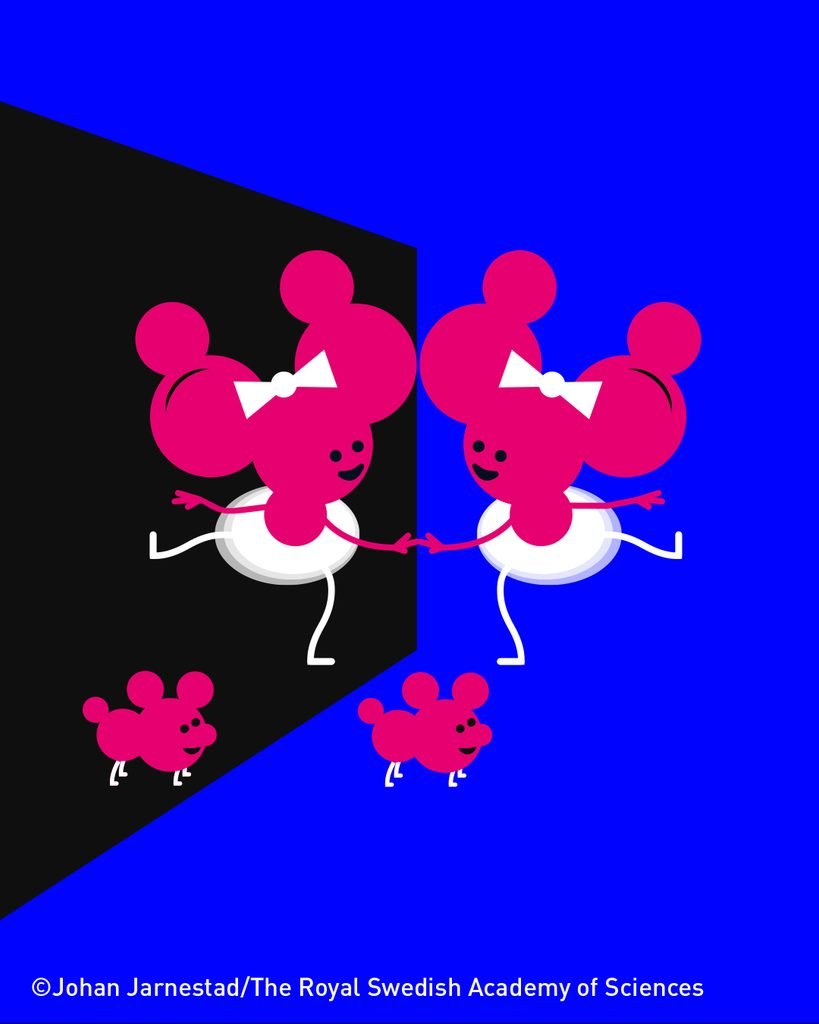
The Nobel Prize in Chemistry 2026 has been awarded to Henri B. Kagan of France and Kenso Soai of Japan. They solved a puzzle that scientists had been stuck on for over a century: why life uses only one “mirror image” of its molecules, and how chemists can make just that one.
Don’t worry if that sounds confusing. This article explains it step by step, in plain words, with no science background needed.
Who Won the Nobel Prize in Chemistry 2026?
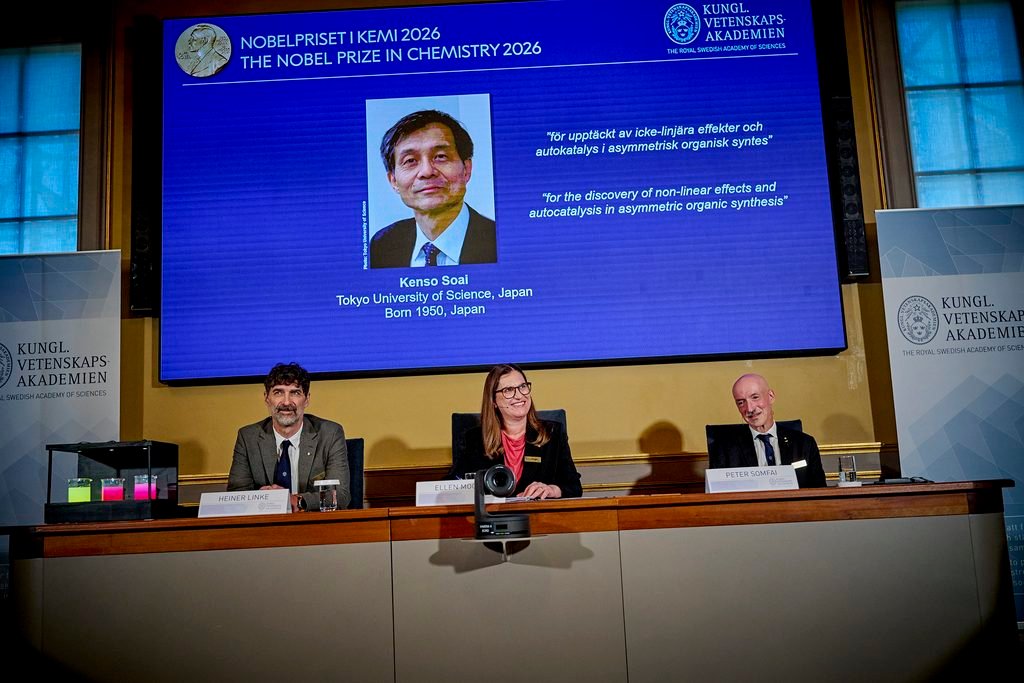
The Royal Swedish Academy of Sciences announced the winners on 7 October 2026 in Stockholm, Sweden. The prize goes to:
- Henri B. Kagan, Université Paris-Sud, France
- Kenso Soai, Tokyo University of Science, Japan
They won “for the discovery of non-linear effects and autocatalysis in asymmetric organic synthesis.” In simple words, they found how chemical reactions can be made to produce only one of two mirror-image molecules.
The prize is 12 million Swedish kronor (about $1.2 million), shared equally. Each winner also gets a medal and a diploma.
Meet the Winners
Henri B. Kagan (France)
- Born in 1930 in Boulogne-Billancourt, France
- Earned his PhD in 1960 at the Collège de France
- Worked at Université Paris-Sud (now part of Paris-Saclay University)
- Now Professor Emeritus
- Made his key discovery in 1986
He is now in his mid-90s. The Royal Society of Chemistry also notes he is the 67th person to win one of its prizes and later get a Nobel.
Kenso Soai (Japan)
- Kenso Soai (Japan)
- Born in 1950 in Hiroshima, Japan
- Earned his PhD in 1979 at the University of Tokyo
- Worked at the Tokyo University of Science
- Now Professor Emeritus
- Published his key experiment in 1995, then perfected it in 2003
Their work is linked. Kagan took the first big step, and Soai built on it years later.
What Is This Discovery? Start With Your Hands
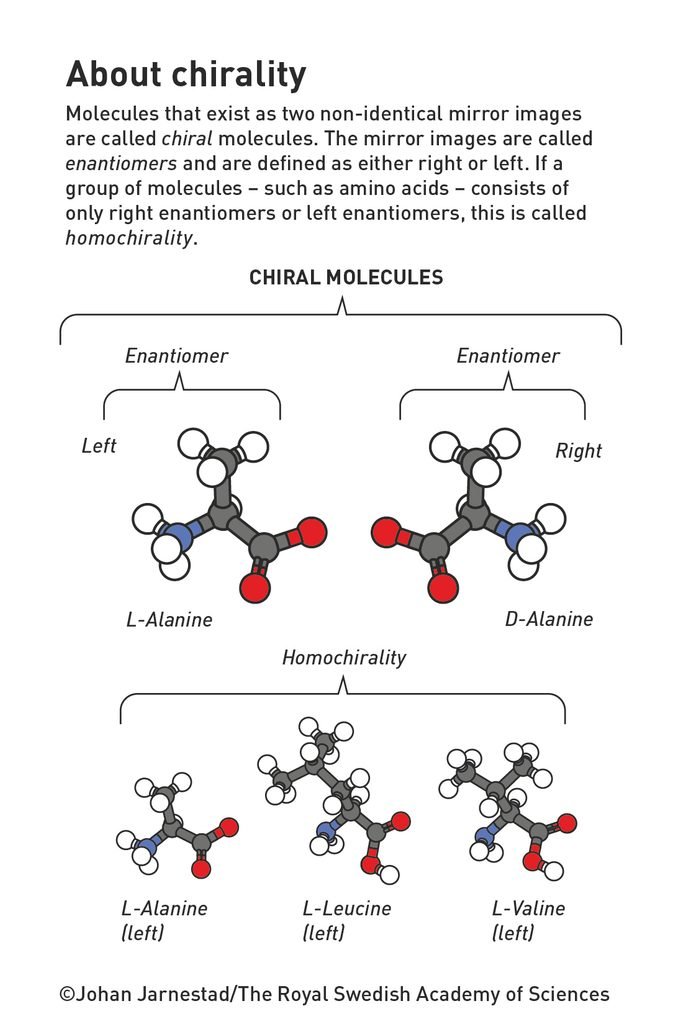
Hold up your left and right hands. They look the same, but you can’t stack one perfectly on the other. They are mirror images.
Many molecules work the same way. A molecule can exist in two versions that are mirror images of each other. Scientists call this property chirality, from the Greek word for “hand.” The two versions are called enantiomers.
Here is the strange part. Your body is built with only one version of each of these molecules.
- The amino acids that make your proteins come in just one “hand.”
- The sugars in your DNA also use just one “hand.”
- The opposite version is rarely found in nature.
Life using only one hand is called homochirality (“same hand”).
Why does this matter? The key-and-lock idea
The Nobel Committee gave a simple example. Imagine you make keys for locks, but every time you make one, you get two keys that are mirror images of each other. Only one fits the lock, and the wrong one can damage the lock. Telling the two apart is very hard.
That is what happens when chemists make medicines. The body is the lock, and the medicine is the key. Often one mirror version works and the other does nothing, or worse, causes harm.
The big mystery
When chemists made these molecules in a lab, they always got a 50-50 mix of both versions. Nature somehow gets just one. For over a century, nobody knew how that could happen on its own.
The 170-Year Story Behind the Discovery
Mid-1800s, Louis Pasteur. While studying a wine-making chemical called tartaric acid, Pasteur noticed its crystals came in two mirror-image shapes. He separated them by hand with tweezers. Each type bent light in the opposite direction. This was the first proof that molecules can have mirror versions. In 1857, he also saw that bacteria would eat only one version.
Early 1900s, Willy Marckwald. This German chemist did the first lab reaction that made more of one mirror image than the other. The difference was tiny, but it proved the idea could work.
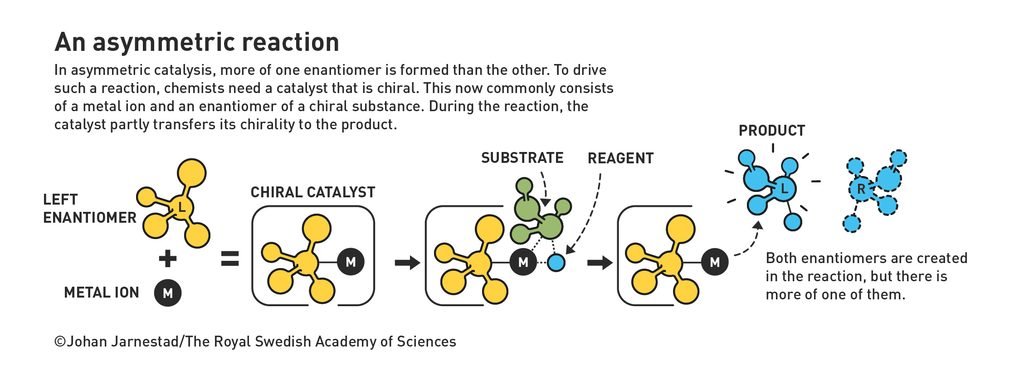
1953, Charles Frank. A physicist from the University of Bristol came up with a mathematical recipe for how one-handed chemistry could appear. His model needed three things:
- A chiral catalyst and a reaction that favors one version
- A way to boost one version and weaken the other
- A reaction that makes its own catalyst, called autocatalysis, so the favored version grows faster and faster
For decades, Frank’s recipe was just theory. This year’s winners made it real.
(Simple definition: a catalyst is a helper substance that speeds up a reaction without being used up.)
What Henri Kagan Discovered in 1986
In the early 1980s, chemists wanted to make medicines in a pure, one-hand form. The pressing reason was the thalidomide tragedy of the early 1960s. Thalidomide was a sedative, and thousands of children were born with birth defects after it was used. At the time, researchers concluded that the mirror-image version of the drug caused the harm. (Later research showed the story is more complicated, but it still taught chemists how important purity is.)
Most chemists believed that the catalyst’s purity passed straight into the product. A catalyst that was 50% pure would give a product that was 50% pure.
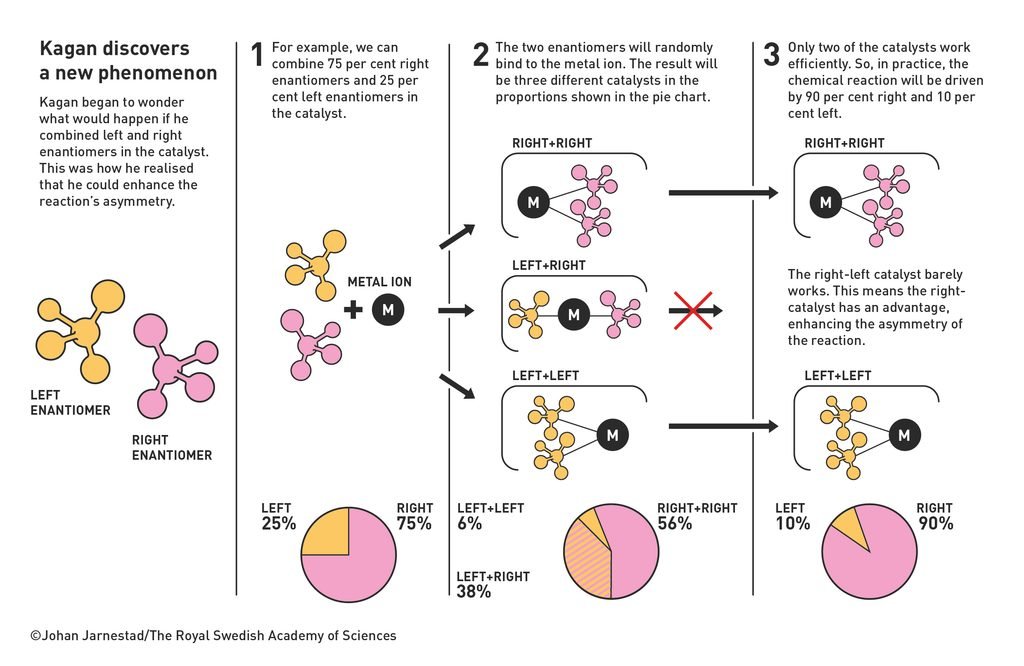
Kagan questioned this. He reasoned that a metal in the catalyst would grab two helper molecules, which created three possible combinations:
- right-right
- left-left
- left-right (a mixed pair)
The mixed left-right version turned out to be lazy, so it worked much more slowly than the other two. That meant the pure versions did most of the work. The final product ended up purer than anyone expected.
When Kagan plotted his results, the graph was curved instead of a straight line. He called this a non-linear effect. In 1986, he published three different reactions that showed it.
In simple words: Kagan found a clever way to get more of the good mirror version than the starting materials seemed to allow.
What Kenso Soai Discovered in 1995 and 2003
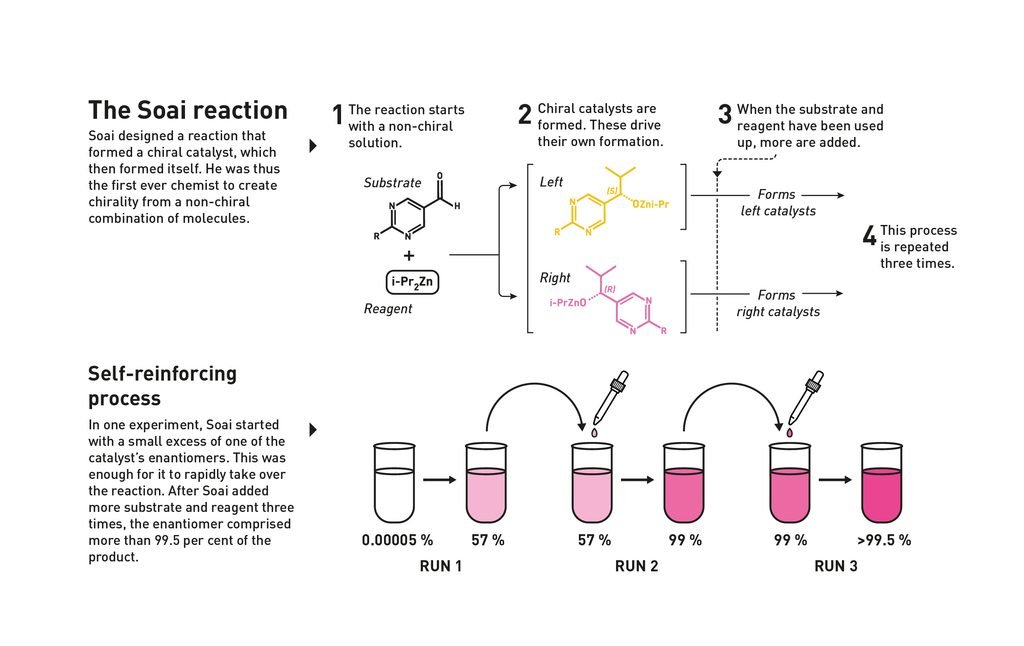
Soai, inspired by this new phenomenon, studied one particular reaction and noticed something. The catalyst and the product looked very similar. That gave him an idea: could the reaction make its own catalyst?
After trying many molecules, he found one called 5-pyrimidyl alkanol that could copy itself.
- 1995: He started with just a 2% extra of one mirror version. By the end, it had grown to 87%. The reaction was reinforcing itself, but it wasn’t perfect yet.
- 2003: After eight more years of work, he perfected the reaction. The favored version reached 99.99%.
This is now called the Soai reaction, and it is considered one of the most elegant experiments ever done. It was the first time anyone besides life itself had made a reaction that produces essentially only one mirror image.
The most amazing part: chance decides
Soai started with no preference. By pure luck, slightly more of one version formed at the beginning. That tiny edge was enough for that version to take over the whole reaction. When he repeated the experiment, sometimes the other version won.
It’s like a tiny snowball rolling downhill. The first small push decides the direction, and then it grows bigger and bigger. Scientists think something like this may have happened at the dawn of life on Earth.
Why This Matters for Medicine
Here is an honest note: the Soai reaction itself is an artificial lab reaction. You won’t find it inside a pill. The medical impact is indirect, through better chemistry tools. Those tools are very powerful, though.
1. Making purer, safer medicines
Many drugs come in two mirror versions. One treats the disease. The other may do nothing or cause side effects. Two real examples:
- Ethambutol, a tuberculosis drug: one version treats TB, while the other can harm eyesight.
- Levodopa, used for Parkinson’s disease: only one version is the useful medicine.
Kagan’s non-linear effects help chemists fine-tune reactions to get the purest possible version. His discovery also gives chemists clues about how a reaction works inside, so they can improve it.
2. Fewer side effects
When a medicine contains only the useful version, patients are not exposed to the unwanted mirror molecule. That can mean fewer side effects and potentially lower doses.
3. Cheaper and greener drug making
If a factory makes a 50-50 mix, it must separate the two versions and often throw half away. Reactions that make mostly one version waste less material and energy. This can help bring costs down.
4. A new path to understanding life’s origins
Around the world, researchers are now trying to repeat Soai’s success with amino acids and sugars, the real building blocks of life. If they succeed, we could finally understand how life became one-handed.
Other Uses Beyond Medicine
The same tools matter for any product that interacts with living things:
- Flavors and fragrances (the two mirror versions of a molecule can smell or taste different)
- Farm chemicals, such as pesticides
- New materials, in some cases
How Will This Help Patients?
Patients won’t see a new pill named after this prize. Instead, the benefits arrive quietly over time:
- Better quality control. Drug makers can make medicines with fewer unwanted molecules.
- Safer medicines. Cleaner production reduces the risk of harmful mirror-image impurities.
- More affordable manufacturing. Less waste can help lower production costs.
- Faster drug development. Chemists with sharper tools can design new medicines more quickly.
This is a foundation, and many future medicines will rest on it.
Note: This article is for general education only and is not medical advice. Talk to your doctor about your own treatment.
Quick Facts
| Fact | Detail |
| Announced | 7 October 2026 |
| Winners | Henri B. Kagan (France) and Kenso Soai (Japan) |
| Prize money | 12 million SEK (about $1.2 million), shared equally |
| Kagan’s key year | 1986 |
| Soai’s key years | 1995 and 2003 |
| Key terms | Chirality, homochirality, non-linear effects, autocatalysis |
| Total chemistry prizes | 118 prizes to 200 laureates since 1901 |
| Related Nobels | Asymmetric catalysis was also honored in 2001 and 2021 |
Frequently Asked Questions
Who won the Nobel Prize in Chemistry 2026?
Henri B. Kagan of France and Kenso Soai of Japan.
What did they win it for?
For discovering non-linear effects and autocatalysis in asymmetric organic synthesis. In plain words, they found how to make chemical reactions produce just one mirror-image molecule.
What is chirality?
It means a molecule has a left-handed and a right-handed version that are mirror images, like your two hands.
What is the Soai reaction?
A reaction designed by Kenso Soai in which a molecule makes copies of itself and, starting from a tiny advantage, ends up almost entirely one mirror version.
How does this help medicine?
It gives chemists better tools to make pure, single-version drugs. That means fewer side effects, less waste, and more efficient drug development.
Why do living things use only one mirror version?
Scientists still don’t fully know. Kagan and Soai showed how it can happen through chemistry, which brings us closer to the answer.
Final Thoughts
For over 100 years, chemists wondered how nature picked one hand out of two. Henri Kagan showed how to amplify a small difference, and Kenso Soai showed a reaction that can grow that difference into almost total purity. Their work gives chemistry sharper tools and brings us closer to understanding where life’s chemistry began.
What do you think about this year’s Nobel Prize in Chemistry? Share your thoughts in the comments below!
Suggested external links: NobelPrize.org and the Royal Swedish Academy of Sciences.
References
- The Royal Swedish Academy of Sciences. “The Nobel Prize in Chemistry 2026: They made chemistry choose a mirror image” (press release), 7 Oct 2026. https://www.kva.se/en/news/the-nobel-prize-in-chemistry-2026/
- The Royal Swedish Academy of Sciences. “They solved chemistry’s asymmetric mystery” (popular science background), 2026. https://www.kva.se/en/prizes/nobel-prizes/they-solved-chemistrys-asymmetric-mystery/
- NobelPrize.org. “Press release: Nobel Prize in Chemistry 2026.” https://www.nobelprize.org/prizes/chemistry/2026/press-release/
- Royal Society of Chemistry. “Henri Kagan and Kenso Soai win 2026 Chemistry Nobel Prize.” https://www.rsc.org/news/nobel-prize-for-chemistry-2026
- C&EN (American Chemical Society). “2026 Chemistry Nobel awarded for chiral chemistry advances.” https://cen.acs.org/people/nobel-prize/chemistry-nobel-chirality-kagan-soai/104/web/2026/10
- CNN. “Henri Kagan and Kenso Soai awarded the Nobel Prize in chemistry for unraveling mystery of mirror molecules,” 7 Oct 2026. https://www.cnn.com/2026/10/07/science/nobel-prize-chemistry-2026-henri-kagan-kenso-soai-winner-intl
Original research papers
- Puchot, C., Samuel, O., Duñach, E., Zhao, S., Agami, C., & Kagan, H. B. (1986). Nonlinear effects in asymmetric synthesis. Examples in asymmetric oxidations and aldolization reactions. Journal of the American Chemical Society, 108(9), 2353-2357.
- Soai, K., Shibata, T., Morioka, H., & Choji, K. (1995). Asymmetric autocatalysis and amplification of enantiomeric excess of a chiral molecule. Nature, 378, 767-768.