

AlphaFold 3 predicts the three-dimensional structure of proteins, and of the DNA, RNA, small molecules and ions they bind, by refining a random cloud of atoms into a coherent structure, using a diffusion model guided by a network called the Pairformer. Published in Nature in May 2024 by Google DeepMind and Isomorphic Labs, it is free for non-commercial research through AlphaFold Server, although its model weights are restricted.
AlphaFold 3 at a glance
| Question | Answer |
|---|---|
| What is it? | A diffusion-based AI model that predicts the joint 3D structure of biomolecular complexes |
| Who built it? | Google DeepMind, with Isomorphic Labs |
| Where was it published? | Nature, May 2024 |
| Which molecules does it cover? | Proteins, DNA, RNA, small-molecule ligands, ions and modified residues |
| Core architecture | A Pairformer network feeding a diffusion module |
| Reported accuracy | Roughly 40% to over 80%, depending on the type of interaction |
| How can researchers use it? | Free, non-commercial access through AlphaFold Server; model parameters on request for non-commercial organisations |
| Is it fully open source? | No. Inference code is public, but the weights are restricted to non-commercial use |
How AlphaFold 3 works, step by step
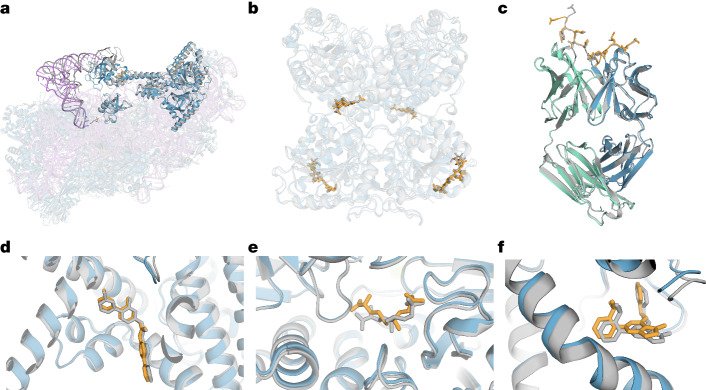
The model turns a list of molecules into atomic coordinates in five stages. Its central idea, borrowed from image generators, is to begin with noise and remove it gradually until a plausible structure remains.
- Input. The user supplies the molecules to be modelled: protein sequences, DNA or RNA sequences, ligands and ions. The system divides this complex into units known as tokens.
- Evolutionary context. It gathers related sequences (a multiple sequence alignment) and structural templates, although their influence is weaker than in AlphaFold 2.
- Pairformer. This network learns which parts of the complex are likely to interact. It replaces AlphaFold 2’s Evoformer and discards the separate alignment representation, working instead on the relationships between pairs of tokens.
- Diffusion. The diffusion module begins with a cloud of atoms placed at random and refines it step by step. During training it received noised atomic coordinates and learned to predict the correct ones, so it outputs raw atom positions rather than protein-specific geometry.
- Sampling and scoring. The process is repeated to produce several candidate structures (five by default on AlphaFold Server), each accompanied by confidence metrics.
AlphaFold 3 vs AlphaFold 2
AlphaFold 3 can do what AlphaFold 2 does, and generally does it better, but it is less freely available.
| Feature | AlphaFold 2 | AlphaFold 3 |
|---|---|---|
| Molecular scope | Proteins (complexes via the Multimer variant) | Proteins, DNA, RNA, ligands, ions, modified residues |
| Main trunk network | Evoformer | Pairformer |
| Structure generation | Deterministic structure module | Diffusion module on raw atom coordinates |
| Role of alignments | Central | Reduced |
| Run-to-run behaviour | Deterministic | Stochastic: repeated runs can differ |
| Licence | Apache 2.0, including commercial use | Non-commercial use only |
How accurate is AlphaFold 3?
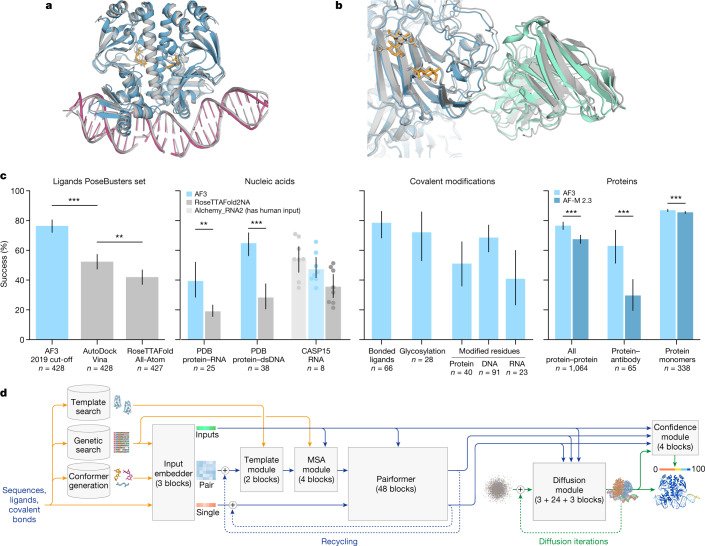
Accuracy depends strongly on the type of interaction: gains over earlier tools are modest for isolated proteins and largest for protein–ligand and antibody–antigen complexes.
| Test | AlphaFold 3 | Comparator | Source |
|---|---|---|---|
| Protein structures, PDB evaluation set | About 84% | 83% (AlphaFold-Multimer 2.3) | The Batch |
| Protein–protein interactions (DockQ) | 77% | 67% (AlphaFold-Multimer 2.3) | The Batch |
| Protein–ligand interactions (PoseBusters) | About 50% more accurate | Best traditional docking methods | The Decoder |
| Overall range across interaction types | Roughly 40% to over 80% | Existing tools, which it beat in almost all categories studied | Axios |
These are the developers’ reported benchmarks. Independent commentary from SciLifeLab likewise found only a slight improvement for single-protein prediction but a larger one for antibody–antigen interactions.
How to read AlphaFold 3 confidence scores
Every prediction should be read alongside its confidence metrics, because the model can return a convincing-looking structure that is wrong.
| Metric | What it measures | How to use it |
|---|---|---|
| pLDDT | Per-residue confidence on a 0 to 100 scale | Higher values indicate a more reliable local structure |
| PAE (predicted aligned error) | Expected positional error between pairs of residues | Low values between two regions suggest their relative placement is trustworthy |
| pTM | A single value for the accuracy of the whole predicted structure | Use as an overall screen |
| ipTM | Accuracy of one component’s placement relative to the others | Use to judge whether an interface or binding partner is credible |
The confidence scores for polymers can change substantially when ions or stabilising ligands are added to, or removed from, the input.
Limitations of AlphaFold 3
- Static output. It predicts a single, unchanging structure and does not describe how a molecule moves.
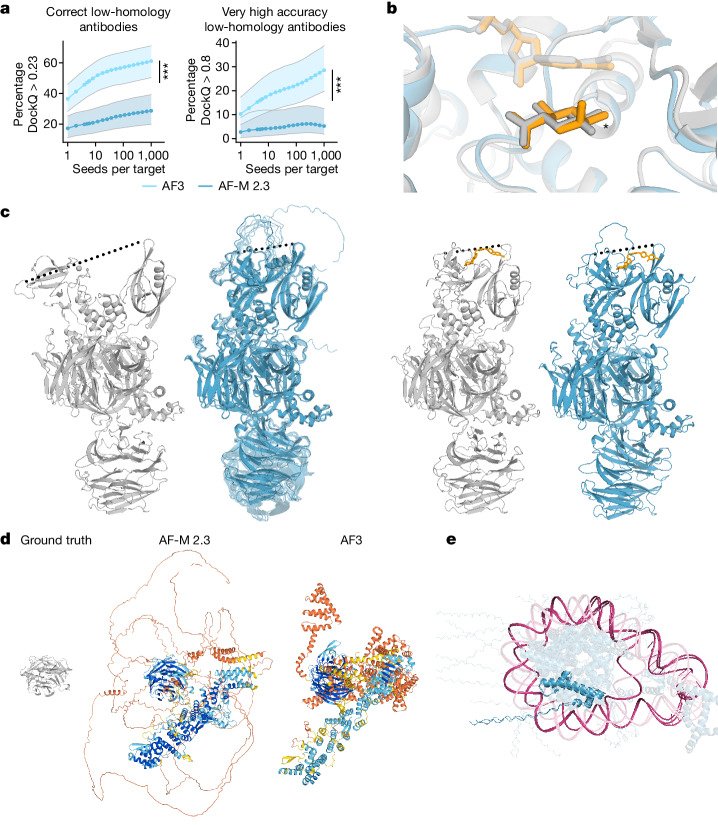
- Hallucination. Because it generates structures by diffusion, it can produce arrangements that look plausible but could not exist physically.
- Variability. Sampling starts from random noise, so separate runs may differ; running the model several times is sensible.
- Uneven accuracy. Performance varies by interaction type, and the developers themselves describe accuracy as something they wish to improve.
- Access constraints. Licensing restricts who may use the model and what the outputs may be used for (see below).
Who can use AlphaFold 3, and how?
AlphaFold 3 is free for non-commercial research but not for commercial work, which is routed through Isomorphic Labs.
| Route | Who is eligible | Conditions |
|---|---|---|
| AlphaFold Server (web) | Individuals and non-commercial institutions for non-commercial research | Free; at launch, limited to 10 jobs per day and 5,000 tokens per job; outputs may not be used with docking or screening tools or to train related machine-learning models |
| Model parameters (self-hosted) | Universities, non-profits, research institutes, educational, journalism and government bodies | Access is requested through DeepMind’s GitHub repository; the parameters must not be shared with commercial organisations |
| Commercial use | Pharmaceutical and other commercial organisations | Not permitted under the academic terms; commercial access is controlled by Isomorphic Labs |
Lawyers have noted that a university project whose sponsor obtains rights to the results may cease to count as non-commercial. Check the current terms before relying on AlphaFold 3 in any sponsored work.
Frequently asked questions
Is AlphaFold 3 free?
Yes for non-commercial research, through AlphaFold Server, subject to daily limits. Commercial use is not free and is handled through Isomorphic Labs.
Is AlphaFold 3 open source?
Not in the way AlphaFold 2 is. AlphaFold 2 is released under the Apache 2.0 licence, whereas AlphaFold 3’s weights are available only on request and only for non-commercial use.
Is AlphaFold 3 a large language model?
No. It is a diffusion-based structure-prediction model, related in technique to image generators rather than to chatbots.
Does AlphaFold 3 replace laboratory experiments?
No. It is far quicker than methods such as X-ray crystallography for a first look at a structure, but its output is a prediction with stated uncertainty and should be validated experimentally where the stakes are high.
Did AlphaFold win a Nobel Prize?
Yes. Demis Hassabis and John Jumper shared the 2024 Nobel Prize in Chemistry for AlphaFold, alongside David Baker for computational protein design.
Sources
- EMBL-EBI: How does AlphaFold 3 work?
- EMBL-EBI: Should I use AlphaFold 2 or AlphaFold 3?
- Model-centric review of deep learning for protein design (arXiv)
- Axios: New AI tool unlocks biology
- MIT Technology Review: AlphaFold 3 can model a much larger slice of biological life
- The Batch: AlphaFold 3 enhances 3D biomolecular modeling
- The Decoder: AlphaFold 3 unveiled
- The Decoder: AlphaFold 3 released for scientific use
- SciLifeLab: AlphaFold3 early pain points
- Foley Hoag: The AI tools speeding up drug discovery come with risky fine print
- iThome: AlphaFold 3 and AlphaFold Server launch details