

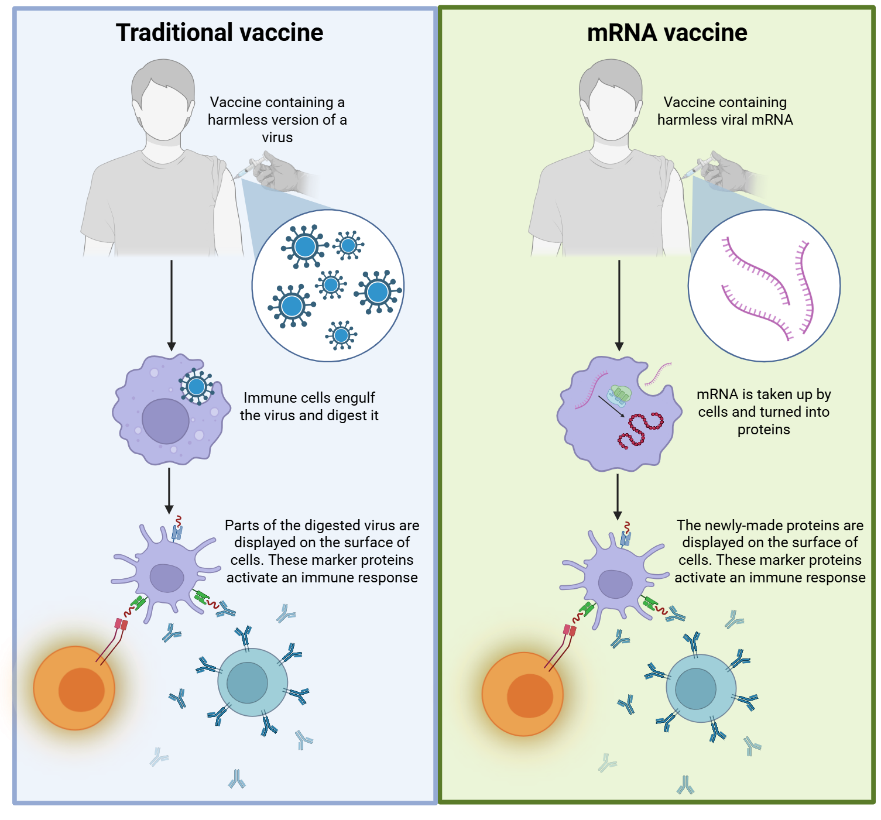
In short: Traditional vaccines train your immune system by showing it a weakened or inactivated germ, or a purified piece of one. mRNA vaccines instead give your cells temporary instructions to make one harmless piece of the germ themselves. Both end with the same result: immune memory. They differ in how they are made, stored and updated.
Last reviewed: Oct, 2026
Quick Comparison: mRNA vs Traditional Vaccines
| Feature | mRNA Vaccines | Traditional Vaccines |
|---|---|---|
| How they work | Deliver mRNA instructions so your cells make a single harmless antigen (e.g., a spike protein) | Deliver a weakened germ, a killed germ, or a purified piece (protein, sugar, toxoid) |
| Manufacturing | Cell-free: mRNA is synthesized in a lab reaction | Usually requires growing the germ or protein in eggs, cell cultures or bioreactors |
| Speed to update | Fast: change the genetic sequence | Slower: new strain must be grown, purified and tested |
| Effect on your DNA | None. mRNA does not enter the cell nucleus | None |
| Storage | Often frozen or ultra-cold (varies by product) | Mostly refrigerated at 2°C to 8°C (some live vaccines are stored frozen) |
| Immune response | Antibodies plus T-cell responses | Varies by type: live vaccines are broad; inactivated and subunit vaccines mainly drive antibodies and often need adjuvants |
| Track record | Newer: first widely used in 2020 | Over 200 years for the earliest vaccines |
How Vaccines Work (The 30-Second Version)
Your immune system learns by recognizing an antigen, a molecule that marks a germ as foreign. Every vaccine’s job is to show your body the antigen safely so it can build antibodies and memory cells. If the real germ shows up later, your body responds faster and harder.
The difference between vaccine types is simply how the antigen gets shown to you.
How mRNA Vaccines Work: A Cellular Production Line
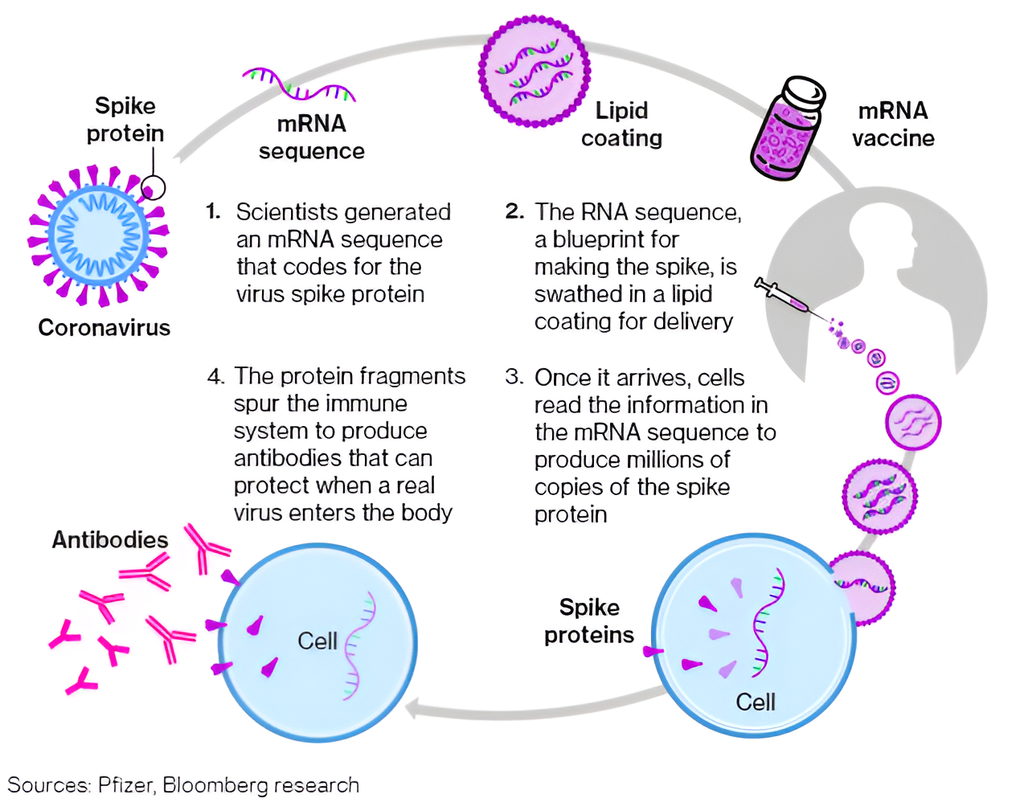
mRNA stands for messenger RNA. It’s a short-lived molecule that cells already use every day to carry instructions from DNA to the protein-making machinery. An mRNA vaccine borrows that system.
Step 1: Lipid Nanoparticles Deliver the Message
mRNA is fragile and would be destroyed quickly on its own. So it’s wrapped in lipid nanoparticles (LNPs), tiny fat-based bubbles that protect it and help it slip into cells near the injection site.
Step 2: Cells Translate the mRNA Into an Antigen
Once inside the cell’s cytoplasm, ribosomes read the mRNA and build the antigen it describes. In the COVID-19 vaccines, that antigen is the spike protein, a single harmless fragment of the virus, not the virus itself. The cell displays it, and your immune system notices.
Step 3: The mRNA Is Broken Down
The mRNA doesn’t stick around. Normal cellular enzymes degrade it, typically within days. The antigen it produced is what trains your immune system.
Which vaccines use mRNA?
The best-known examples are the Pfizer-BioNTech and Moderna COVID-19 vaccines. An mRNA vaccine against RSV has also been approved. Many more are in clinical trials, including for flu, other infectious diseases and some cancers.
How Traditional Vaccines Work: Direct Pathogen Exposure
“Traditional” covers several different designs, which is why this comparison isn’t just “old vs new.”
Live-Attenuated Vaccines
These contain a living but weakened version of the germ that can replicate a little without causing serious disease. They tend to produce strong, long-lasting immunity. Examples: MMR (measles, mumps, rubella), varicella (chickenpox), oral polio vaccine in some countries. Limitation: Generally not recommended for people who are severely immunocompromised, and usually avoided during pregnancy.
Inactivated Vaccines
The germ is killed so it can’t replicate, but your immune system can still recognize it. Examples: Injectable polio vaccine (IPV), hepatitis A, many flu shots. Limitation: Often need multiple doses or boosters.
Subunit, Recombinant and Conjugate Vaccines
Only a purified piece of the germ is used, such as a protein or sugar coating. Examples: Hepatitis B, HPV, Hib, pneumococcal conjugate vaccines.
Toxoid Vaccines
These target the harmful toxin a bacterium makes rather than the bacterium itself. Examples: Tetanus and diphtheria.
Adjuvants: Helping the Immune System Notice
Inactivated and subunit vaccines are often paired with adjuvants, ingredients (such as aluminum salts) that boost the immune response so a small amount of antigen is enough.
A third category: viral vector vaccines. These use a harmless, modified virus to carry genetic instructions into cells. Some COVID-19 vaccines used this approach. They’re newer than classic vaccines, so they sit between the two groups in this article.
Head-to-Head: Manufacturing, Safety and Immune Response
Manufacturing and Speed
Many traditional vaccines require growing a germ or protein at scale. Some flu vaccines, for example, are grown in chicken eggs or cell cultures, which takes months and must be planned well in advance.
mRNA vaccines are made in a cell-free process. Once the genetic sequence of the target is known, the mRNA is synthesized in a lab reaction and packaged into lipid nanoparticles. That’s why the first COVID-19 mRNA vaccine candidates were designed within days of the virus’s genetic sequence being published, and why mRNA is attractive for fast-moving outbreaks.
Fair caveat: Manufacturing speed isn’t the whole timeline. Safety trials, regulatory review and large-scale production still take time.
Updating Against New Variants
Because an mRNA vaccine is defined by its sequence, scientists can edit that sequence to match a new variant. Updating a traditional vaccine often means growing and purifying a new batch of the germ or protein.
Immune Response Profile
- Antibodies (humoral immunity): Both vaccine types can produce them.
- T cells (cellular immunity): mRNA vaccines prompt both CD4+ helper T cells and CD8+ killer T cells. Live-attenuated vaccines also drive strong T-cell responses, while inactivated and subunit vaccines mainly rely on antibodies and often need adjuvants to do more.
Storage and Logistics
Early mRNA COVID-19 vaccines needed freezers, with Pfizer-BioNTech’s original formulation requiring ultra-cold storage, because mRNA and its lipid shell are chemically delicate. Newer formulations and later products have eased these requirements. Most traditional vaccines are stored at 2°C to 8°C, though a few live vaccines (such as varicella) are stored frozen. Always check the specific product’s storage guidance.
Safety
Both types go through clinical trials and ongoing safety monitoring after approval.
- Common side effects of both: Sore arm, tiredness, headache, low-grade fever for a day or two.
- mRNA vaccines: Rare cases of myocarditis (heart inflammation) have been reported, mostly in adolescent and young adult males after the second dose of COVID-19 mRNA vaccines. Most cases were mild and resolved, and the risk of heart complications from COVID-19 infection itself has been found to be higher.
- Live-attenuated vaccines: Can cause serious illness in rare cases in people with severely weakened immune systems.
No vaccine is zero-risk. The question regulators ask is whether the benefits clearly outweigh the risks for the people who receive it.
Durability: Do mRNA Vaccines Last as Long?
Protection length depends more on the disease and the immune response to it than on the vaccine platform. Some traditional vaccines (like MMR) provide very long protection, while others (like tetanus) need boosters every few years. Antibody levels after COVID-19 mRNA vaccination declined over months, which is why boosters were recommended, but this is partly a feature of the virus and how quickly it changes.
Common Myths vs Scientific Reality
Myth 1: “mRNA vaccines alter your DNA.”
Reality: mRNA vaccines don’t change your genetic code. DNA is stored in the cell nucleus, and the vaccine’s mRNA stays in the cytoplasm, where it’s read and then broken down. Human cells don’t copy mRNA back into DNA as part of normal function, so the vaccine has no route into your genome.
Myth 2: “Traditional vaccines are safer because they’ve been around longer.”
Reality: A longer track record is reassuring, but “older” doesn’t automatically mean “safer.” Each vaccine is judged on its own evidence. Live-attenuated vaccines, for example, carry precautions that mRNA vaccines don’t, because mRNA vaccines contain no live germ. On the other hand, mRNA vaccines have a shorter history, which is why long-term monitoring continues.
Myth 3: “mRNA vaccines give you the virus.”
Reality: They contain no virus at all, only instructions for one harmless protein fragment. They cannot cause the disease they protect against.
Myth 4: “mRNA vaccines were rushed and skipped steps.”
Reality: Decades of earlier mRNA research made speed possible. Clinical trials, regulatory review and post-approval monitoring still took place. Timelines were compressed mostly through parallel work and massive funding, not by dropping safety requirements.
Which Is Better: mRNA or Traditional?
Neither is universally better. They’re different tools:
- mRNA shines when speed and adaptability matter, such as new pandemic threats or rapidly mutating viruses.
- Traditional platforms are proven, often cheaper, and well-suited to diseases with established vaccines and simpler storage needs.
For your own health decisions, talk to a doctor or pharmacist about which vaccines are recommended for your age, health conditions and country.
Frequently Asked Questions
Do mRNA vaccines last as long as traditional vaccines?
It depends on the disease, not just the vaccine type. Some traditional vaccines give decades of protection, others need regular boosters, and the same is true for mRNA vaccines. Duration is influenced by how the pathogen behaves and how it changes over time.
Are mRNA vaccines faster to produce for new pandemics?
Yes. Because they’re made from a genetic sequence instead of grown germs, mRNA vaccines can be designed and manufactured much more quickly than most traditional vaccines. Testing and approval still take time.
Why do some mRNA vaccines require freezer storage?
mRNA is a fragile molecule and its fatty protective coating is sensitive to temperature. Cold storage keeps them stable. Newer formulations have reduced these requirements.
Can mRNA vaccines change my DNA?
No. The mRNA never enters the cell nucleus where DNA is stored, and it’s degraded by the cell within days.
Are traditional vaccines still relevant?
Absolutely. Vaccines such as MMR, polio, hepatitis B and tetanus protect millions of people every year, and traditional platforms remain the backbone of immunization programs worldwide.
Key Takeaways
- Traditional vaccines show your body the germ (weakened or killed) or a piece of it; mRNA vaccines give your cells instructions to make one piece.
- mRNA never enters the nucleus and doesn’t change your DNA.
- mRNA vaccines can be designed and updated faster, and are made without growing the germ.
- Traditional vaccines have the longer track record and usually simpler storage.
- Both are monitored for safety, and the best choice depends on the disease and the person.
Sources and Further Reading
Link each of these to the specific page in your final post:
- CDC: Understanding How Vaccines Work, and Understanding mRNA COVID-19 Vaccines
- World Health Organization: vaccine types and mRNA vaccine explainers
- FDA: approved vaccines list and vaccine safety information
- Mayo Clinic: mRNA vaccine and vaccine-type overviews
- NIH / NIAID: vaccine types and platforms
- Peer-reviewed reviews on mRNA vaccine technology (search PubMed / PMC for recent reviews)
Disclaimer: This article is for general education and is not medical advice. Talk to a qualified healthcare professional about vaccination decisions.