

Type 1 diabetes starts years before anyone feels sick, affects about 9.5 million people worldwide, and is the story of a body that mistakes its own cells for enemies.
The big picture
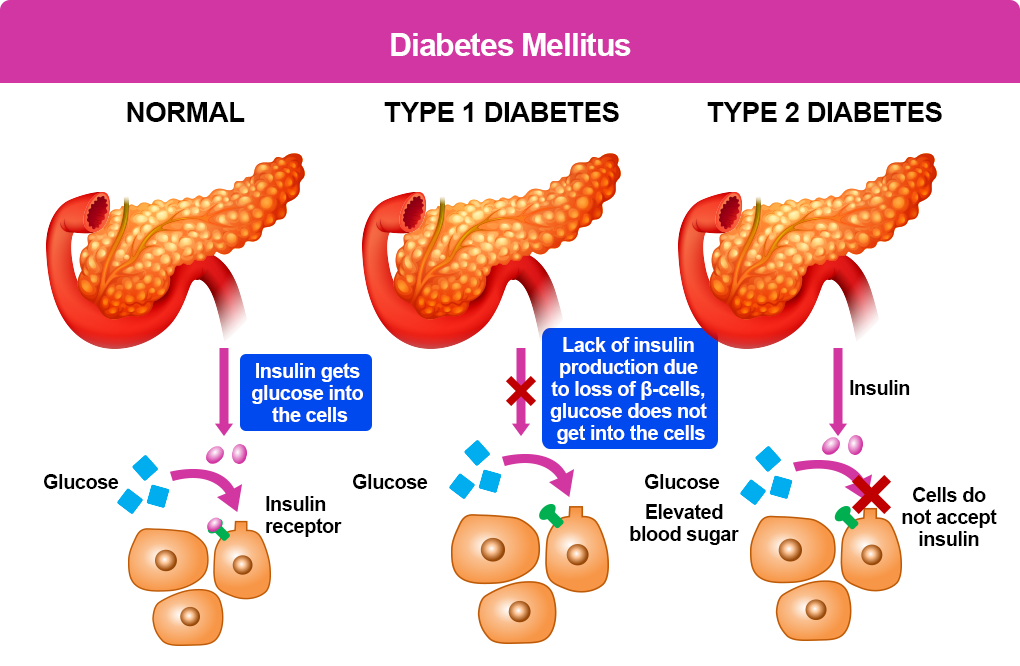
Inside your pancreas sit tiny cells called beta cells. Their only job is to make insulin, the key that lets sugar leave your blood and enter your body’s cells as fuel. In type 1 diabetes (T1D), the immune system destroys these cells. Without insulin, sugar piles up in the blood, and a person cannot live without insulin from outside the body.
T1D is not caused by eating too much sugar, and it is not the same disease as type 2 diabetes. It is an autoimmune disease: the body’s own defence force turns on a part of the body.
- 9.5 million people were living with T1D in 2025, up from 8.4 million in 2021, a rise of 13%.
- 1.85 million of them are under 20. By simple subtraction, roughly 4 in 5 people with T1D are adults.
- 14.7 million is the projected number for 2040 (plausible range 11.5 to 19.3 million).
- Up to about 15% of newly diagnosed people have a relative with T1D. For most people, it arrives with no warning from family history.
In this blog we walk through how the disease starts, how it shows itself, what causes it, where in the world it is most common, how it is treated in 2026, and what science still cannot explain. At the end, we step back and ask what a disease like this teaches us about the body, and about ourselves.
The three stages: a disease that begins in silence
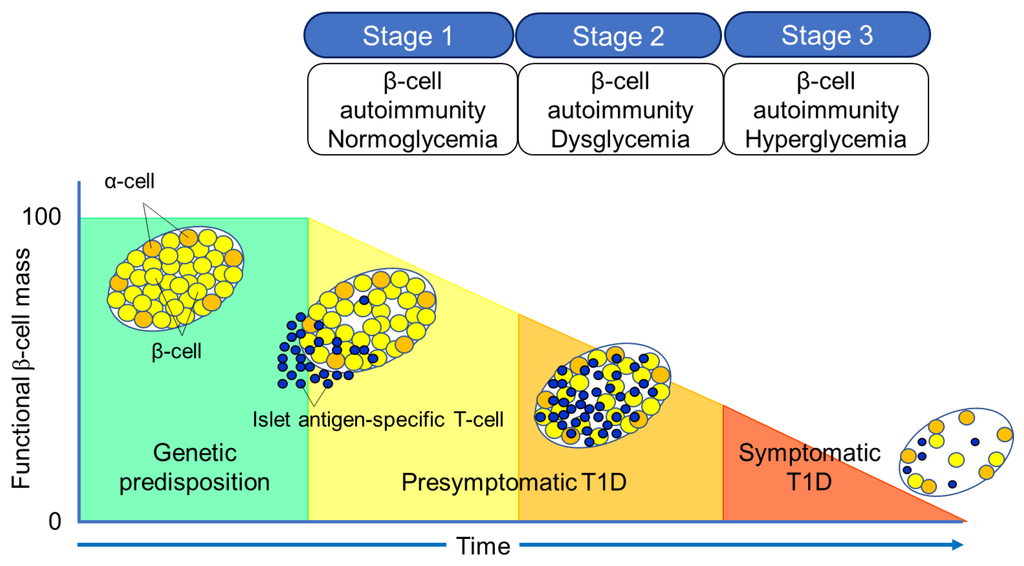
For a long time, doctors thought T1D began on the day a child became sick. We now know that day is the end of a long story. In 2015, JDRF, the Endocrine Society and the American Diabetes Association agreed on three stages, and this is still the standard way to describe the disease.
| Stage | What is happening inside | How the person feels | Chance of reaching symptoms |
| 1 | Two or more islet autoantibodies (marker proteins showing the immune attack has begun). Blood sugar still normal. | Fine. No symptoms. | About 44% within 5 years, 70% within 10 years, close to 100% over a lifetime (in children) |
| 2 | Same antibodies, plus blood sugar that is starting to misbehave as beta cells are lost. | Usually still fine. | About 75% within 5 years |
| 3 | Too few beta cells are left to control blood sugar. | Thirst, frequent urination, weight loss, tiredness. | This is the diagnosis. |
Three facts from the staging paper stand out:
- The first antibodies appear very early. They show up after 6 months of age, peak between 9 and 24 months, and have a median first-detection age of 15 months in children followed from birth.
- The speed varies enormously. Moving from stage 1 to stage 3 can take months or decades.
- One antibody is much less worrying than two. About 85% of people with a single antibody do not develop symptomatic T1D within 10 years.
Why stages matter. Children found early in research studies arrived at diagnosis in much better shape. In the DAISY study, only 3% of children found through monitoring were hospitalised at diagnosis, compared with 44% of matched children diagnosed in the community. The paper’s authors note that this staging was meant for research at the time (2015), because there was no proven treatment for the early stages. That changed in 2022, as the treatment section shows.
Symptoms: the four Ts, and the emergency behind them
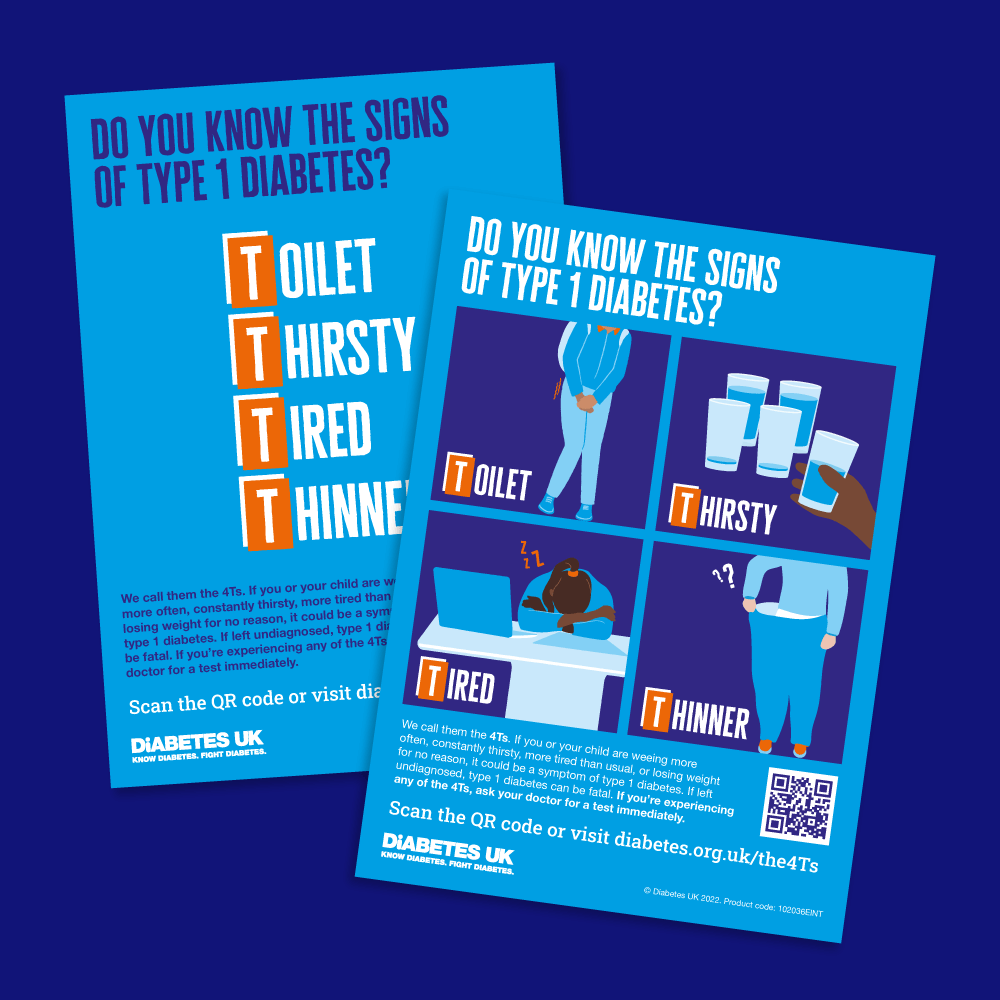
Diabetes organisations around the world teach the same simple memory aid, the 4 Ts:
- Toilet: peeing much more than usual, or a child who was dry now wetting the bed.
- Thirsty: a thirst that water does not fix.
- Tired: more worn out than normal.
- Thinner: weight loss without trying.
Other signs include fruity-smelling breath, blurry vision, strong hunger, nausea or vomiting, and cuts that heal slowly. Not everyone has all four Ts. A teenager may be thirsty and tired but not lose weight; an adult may only notice frequent urination.
Why this matters. If insulin is too low for too long, the body burns fat in a panic and makes acids called ketones. This is diabetic ketoacidosis (DKA), a life-threatening emergency. Its warning signs are fast, heavy breathing, vomiting, stomach pain and confusion. DKA needs a hospital, not a wait-and-see approach.
How often children arrive at diagnosis already in DKA depends heavily on where they live:
| Where / who | Share in DKA at diagnosis |
| Sweden, Slovakia, Canada (lowest in a 31-country review) | As low as 12.8% (the review’s range was 12.8% to 80%, using studies up to 2011) |
| Colorado, USA (2012) | 46% |
| Typical US youth (SEARCH study) | About 30% |
| Nigeria (hospital study, Benin City) | 77% |
| Tigray, Ethiopia (hospital study) | 79% |
| Children screened early in Bavaria (Fr1da) | Very low: of 280 children found with early-stage T1D, only 2 who went on to symptoms had DKA |
The same review found DKA was less common in richer countries, in countries farther from the equator, and where T1D itself is more common. A likely reason: where doctors expect the disease, they find it sooner. Death from DKA is also very uneven: reported at 0.15 to 0.35% in wealthy countries and 3.4 to 13.4% in developing countries, according to a Jordanian study summarising earlier work.
The lesson: the symptoms are not mysterious. What is missing in many places is the habit of thinking of T1D when a child is thirsty and losing weight.
The mechanism: how a body turns on itself
Think of the immune system as a security force trained to attack invaders and ignore the home team. In T1D, the training goes wrong for one specific group of insiders, the beta cells.
- A target is chosen. The immune system starts to treat certain beta-cell proteins as foreign: insulin itself (or its precursor, proinsulin), GAD65, IA-2 and ZnT8.
- Soldiers and markers appear. T cells, a type of white blood cell, are thought to do most of the damage. They are rare in the blood and hard to measure, so doctors track the antibodies instead. These are easy to test for and act like footprints showing that the attack has started.
- The damage builds quietly. Beta cells are lost over months to years. At first the remaining cells compensate, so blood sugar looks normal (stage 1). Then the insulin response to a meal weakens and sugar starts to rise (stage 2). In the last year or two before diagnosis, the decline speeds up.
- Symptoms arrive. Once insulin cannot keep up, sugar floods the blood and the 4 Ts begin (stage 3).
Two surprises complicate this tidy story:
- Two versions of the disease may exist. In the TEDDY study, children whose first antibody was against insulin tended to differ in genes and triggers from children whose first antibody was against GAD65. The insulin-first group tends to get sick earlier. Researchers call these possible “endotypes”.
- The beta cells are not always completely gone. Studies of donated pancreases found some insulin-making cells even in people who had lived with T1D for decades, and about 37.7% of people in one Scottish group still had detectable C-peptide, a by-product of insulin made by their own body. A review in Diabetologia asks whether those cells are “sleeping or dead”. Nobody yet knows for sure, and the answer matters for cure research.
Risk factors: how each one adds to the risk
Genes set the stage; something in the world seems to start the play. Neither side explains T1D alone, and the evidence is much stronger for genes than for environment.
| Risk factor | How it adds risk | How sure are we? |
| HLA genes (on chromosome 6; the DR3-DQ2 and DR4-DQ8 types) | Account for about 30 to 50% of the genetic risk. These genes shape how immune cells recognise “self”. A child with high-risk HLA types has about a 4% chance, compared with 0.4 to 1% for a typical newborn. Other HLA types (such as DQB1*0602) protect. | Very strong. But most children with high-risk HLA never develop T1D. |
| About 50 other genes (such as INS, PTPN22, CTLA4, IL2RA) | Each adds a small push. Several also change how fast the disease moves from antibodies to symptoms. | Strong, but each one is small. |
| A close relative with T1D | A first-degree relative is at roughly 10 to over 100 times the general risk, depending on genes. Having several affected relatives raises it to 20 to 25%. | Very strong. |
| Being an identical twin of someone with T1D | Up to 65 to 70% will develop it. | Strong. Since it is not 100%, something outside the genes must matter. |
| Enterovirus infections (such as coxsackie viruses) | May start or speed up the attack on beta cells. TEDDY found signals linking enterovirus to both T1D and coeliac disease. | Among the best-supported environmental clues, but causation is not proven. |
| Rapid weight gain in early life | Linked to higher risk in a major review of the evidence. | Moderate. |
| Gut microbiome (the bacteria in the gut) | Children who develop autoimmunity show differences in gut bacteria. | Moderate. We do not know if the differences are cause or effect. |
| Diet, vitamin D, antibiotics, birth route, breastfeeding | Many studied; no firm causal link established. | Weak or unproven. |
| Age and sex | Antibodies appear earliest in babies and toddlers. Progression is faster in younger children and in girls. In adults, onset is more common in men. | Moderate. |
Two important points from the staging paper:
- Environment cannot yet be used to predict who gets sick. Because no environmental cause has been conclusively proven, it is not part of screening or staging today.
- Genes alone do not explain the rise. T1D cases have risen faster than genes can change. Over recent decades, the share of patients carrying the very highest-risk HLA type has fallen, which means more people with lower genetic risk are being pulled into the disease. Something in modern life is changing the odds, and we have not yet found it.
The world map: a 780-fold gap
Here is the most surprising number in T1D: a child in Finland is roughly 780 times more likely to develop the disease each year than a child in Papua New Guinea. Same disease, same human biology, and a gap this wide. Nobody can fully explain it.
Where it is most and least common (new cases per 100,000 children aged 0 to 14, per year):
| Place | New cases per 100,000 per year | Note |
|---|---|---|
| Finland | About 62.5 (mean 2006 to 2011) | The world’s highest recorded rate. It climbed about 3.6% a year until 2005, then levelled off. |
| Sardinia, Italy | About 36.8 | Matched Finland (about 37 per 100,000) in 1990s data, when both were the highest recorded. |
| Sweden, Norway | 30 or more | Northern Europe holds the top of the list. |
| Saudi Arabia | About 33.5 (IDF 2017 edition) | Among the highest outside Europe. |
| China (Zunyi) | About 0.1 | Among the lowest recorded, though rates in China have risen since. |
| Venezuela (Caracas) | About 0.1 | Among the lowest recorded. |
| Papua New Guinea | About 0.08 | The lowest rate reported. |
These rates come from older registries and some places have no recent data, so treat them as a picture of the contrast, not of today’s exact figures.
Where the most people live with T1D (all ages, IDF Atlas 11th edition, 2025). Big countries top this list simply because they have more people:
| Rank | Country | People with T1D |
|---|---|---|
| 1 | United States | Highest (figure not captured here) |
| 2 | India | 987,000 |
| 3 | China | 626,000 |
| 4 | Brazil | 517,000 |
| 5 | United Kingdom | 341,000 |
| 6 | Germany | 338,000 |
| 7 | Russian Federation | 289,000 |
| 8 to 9 | Canada, Saudi Arabia | Not captured here |
| 10 | Turkey | 207,000 |
Two more facts that change the picture:
- The burden is moving south and east. In 2021, about 1.8 million people with T1D (one in five) lived in low and lower-middle income countries. By 2040, the steepest percentage rises are expected there.
- Many people are missing. The 2021 model estimated 3.7 million “missing” cases, people who were never diagnosed or died before they could be counted. For 119 countries there is still no direct data at all, and numbers are borrowed from similar neighbours.
Treatment today: from managing the disease to slowing it
There is still no cure. Every person with T1D needs insulin for life. But the toolbox now reaches several stages of the disease, from the quiet early years to daily life with insulin.
| Tool | What it does | What the evidence shows |
|---|---|---|
| Insulin (injections or pump) | Replaces the insulin the body cannot make. | Essential. Without it, T1D is fatal. |
| Automated insulin delivery (a sensor, a pump and an algorithm that adjusts insulin by itself, often called an “artificial pancreas”) | Reads glucose every few minutes and changes insulin doses automatically. | In a 6-month randomized trial of 168 people, time in the target range (70 to 180 mg/dL) rose from 61% to 71%, while the comparison group stayed at 59%. Time spent low fell too. A review of 12 trials in 993 children found about 11 percentage points more time in range. |
| Teplizumab (Tzield) | An antibody given as a 14-day infusion that calms the immune cells attacking beta cells. | Approved by the US FDA in November 2022 for people aged 8 and older in stage 2. In April 2026 the FDA widened this to children aged 1 and older, based on a small safety study of 23 children. Of 76 patients, 45% on the drug developed stage 3 over a median 51 months, against 72% on placebo. The typical delay was 50 months versus 25 months. |
| Donor islet cells (Lantidra) | Transplants insulin-making cells from deceased donors. | The only FDA-approved cell therapy for T1D. Needs lifelong immune-suppressing drugs. |
| Stem-cell islets (zimislecel, still experimental) | Lab-grown insulin-making cells infused into the liver’s blood vessel. | In a small study, all 12 people made their own insulin again and 10 of 12 (83%) needed no insulin injections one year later. |
What the numbers mean in everyday life. Ten extra percentage points of time in range is about 2.4 more hours every day with healthy blood sugar. In a pooled analysis of three studies with 369 people (256 of them on the Control-IQ system), time in range for Control-IQ users rose from 57% to 70% over 13 weeks. A February 2026 trial found that an open-source system without meal announcements reached a similar time in range (66% against 69%), a step toward a pump that needs less effort from the person wearing it.
What the numbers do not mean.
- Teplizumab delays T1D; it does not prevent it. Two extra years can still mean two more years of school, growth and normal life before daily insulin begins, but the trial was small (76 people).
- Zimislecel needs immune-suppressing drugs, which carry their own risks, and most side effects in the trial came from those drugs. The company dropped a related approach that tried to avoid immunosuppression (VX-264) in 2025. As of its January 2026 update, Vertex had completed enrolment in its larger trial but temporarily postponed finishing the dosing pending a manufacturing review. It had planned regulatory filings in 2026. I could not confirm that a filing has happened yet, so check the company’s latest news. Vertex estimates it would suit about 60,000 people in the US, Canada and Europe with the most severe form of the disease. Two participants died during an earlier trial; reporting says neither death is believed to be caused by the therapy (one followed an infection after sinus surgery while on immune-suppressing drugs, the other a head injury after a severe low blood sugar).
Finding it early. The Fr1da study in Bavaria, Germany, screened 90,632 children with a simple blood test. It found 280 children (0.31%) with early-stage T1D, and about a quarter of them developed symptoms during follow-up. Fewer than 5% of the screened children arrived in DKA, compared with about 20% of unscreened children in Germany. Screening costs and what to do with the result are still being studied.
What we know, what we don’t, and where the gaps are
What we know well
- T1D is an autoimmune disease in which immune cells destroy beta cells, and antibodies in the blood mark the process years in advance.
- Once a child has two or more islet antibodies, close to everyone eventually develops symptoms.
- HLA genes are the biggest genetic factor, followed by about 50 smaller ones.
- Blood sugar control can be improved a lot with sensors and automated pumps.
- Disease progression can be delayed, at least in stage 2.
- Catching T1D before symptoms sharply reduces dangerous DKA at diagnosis.
What we do not know
- What starts the attack. Viruses, early weight gain and gut bacteria are suspects, but none is proven as a cause.
- Why the world is so uneven. Finland, Sweden and Norway sit at the top of the table, while Estonia and Iceland have far lower rates despite similar ancestry. Genes alone cannot explain this.
- What controls the speed. Moving from stage 1 to symptoms takes months in some people and decades in others. We cannot yet predict who will be fast or slow with confidence.
- Whether leftover beta cells can wake up. Some remain after many years, but evidence that they can be revived in long-standing T1D is limited.
- Whether T1D is one disease or several. The insulin-first and GAD65-first patterns suggest at least two types. A small number of people who look like they have T1D have no detectable antibodies at all.
The gaps that matter most
| Gap | Why it matters |
|---|---|
| Missing data. 119 countries have no direct T1D data, and adult data comes from only about 21 countries. | We cannot plan insulin supplies, clinics or screening for numbers we cannot count. |
| Screening that misses most people. Only up to about 15% of new cases have a relative with T1D. | Testing only relatives leaves the great majority unseen. Population screening is being tested but is not standard care. |
| Borrowed diagnostic thresholds. The blood-sugar and HbA1c cut-offs used for stage 2 were designed for type 2 diabetes. | Nobody knows if they are the best moment to start insulin or treatment in T1D. |
| No way to see the attack. Doctors cannot yet image the inflamed pancreas in early stages. | Earlier markers (such as immune signatures in newborn blood) might allow a new “stage 0”, but are unproven. |
| Delay, not prevention. The only approved early treatment postpones T1D by a median of about two years. | A treatment that stops the disease, or works before stage 2, does not yet exist. |
| Cure limited by immune suppression. Cell replacement works, but the immune system rejects the new cells. | Lifelong immune-suppressing drugs are a hard trade for a child or a healthy adult. |
| Access to basics. Death from DKA runs at 3.4 to 13.4% in developing countries versus 0.15 to 0.35% in wealthy ones. | The cheapest tools (insulin, glucose tests, awareness) save more lives today than any new drug. |
The philosophy: a disease of mistaken identity
This section is reflection, not data. The facts behind it are in the sections above.
Most diseases come from outside: a germ, a poison, an injury. T1D comes from inside, and from the most loyal part of us. The immune system is not broken or malicious. It is doing exactly what it was built to do, protect “me” from “not me”, and it has drawn the line in the wrong place. T1D is a disease of recognition: the body failing to know itself.
1. When does a disease begin? Under the old view, T1D began the day a child became ill. Under the new view, it began years earlier, at stage 1, when the person feels perfectly well. A child with two antibodies has, by the numbers, a near-certain future (close to 100% over a lifetime) while looking and feeling healthy. Are they sick? Healthy? Something in between that our language has no word for? Medicine has quietly turned “illness” from an event into a process.
2. Is it kind to know the future? Screening saves lives: in Bavaria, fewer than 5% of screened children arrived in DKA versus about 20% of unscreened ones. But it also hands a family a prediction years before anything happens. Knowledge is a gift when it comes with a plan, and a weight when it does not. This is why the arrival of a drug that delays stage 3 changed the moral weather: a prediction you can act on is a different thing from a prediction you can only wait for.
3. A lottery you did not enter. About 85% or more of people diagnosed have no relative with T1D, and nothing the person ate or chose is known to have caused it. And yet life with T1D demands constant decisions that a healthy pancreas makes silently, without asking. Few illnesses make the distinction between what happens to you and what you must then do so sharp.
4. Is survival a postal code? The biology of a beta cell is the same in Helsinki, Port Moresby and Karachi. The chance of surviving the diagnosis is not: DKA kills 0.15 to 0.35% of children in wealthy countries and 3.4 to 13.4% in developing ones, according to published studies. The first lottery, who gets sick, is blind. The second lottery, who is treated in time, is not. Justice, in T1D, mostly means insulin, a glucose meter and a doctor who thinks of the disease in time.
5. Where does the self end? When a sensor, a pump and an algorithm keep a person’s sugar steady, an organ’s work is being done outside the body by something written in code. Many people already live this way. It forces an old question into daily life: is the self the body, the choices, or the whole system that keeps a person alive?
Perhaps the deepest lesson is humbling. We built our picture of health on the assumption that the body knows itself. T1D is the evidence that this knowledge is something the body must keep getting right, every day, for decades. A cure, if it comes, will not just replace cells. It will mean teaching a body to recognise itself again.
References
- Insel RA, Dunne JL, Atkinson MA, et al. Staging presymptomatic type 1 diabetes: a scientific statement of JDRF, the Endocrine Society, and the American Diabetes Association. Diabetes Care. 2015;38(10):1964–1974. doi:10.2337/dc15-1419. Link
- Global type 1 diabetes prevalence, incidence, and mortality estimates 2025: results from the International Diabetes Federation Atlas, 11th edition, and the T1D Index version 3.0. Diabetes Res Clin Pract. 2025. Link
- Gregory GA, Robinson TIG, Linklater SE, et al. Global incidence, prevalence, and mortality of type 1 diabetes in 2021 with projection to 2040: a modelling study. Lancet Diabetes Endocrinol. 2022;10(10):741–760. Link
- Ogle GD, James S, Dabelea D, et al. Global estimates of incidence of type 1 diabetes in children and adolescents: results from the International Diabetes Federation Atlas, 10th edition. Diabetes Res Clin Pract. 2022. Link
- Quinn LM, Wong FS, Narendran P. Environmental determinants of type 1 diabetes: from association to proving causality. Front Immunol. 2021;12:737964. doi:10.3389/fimmu.2021.737964. Link
- Reichman TW, Markmann JF, Odorico J, et al. Stem cell-derived, fully differentiated islets for type 1 diabetes. N Engl J Med. 2025. doi:10.1056/NEJMoa2506549. Link
- US Food and Drug Administration. FDA approves first drug that can delay onset of type 1 diabetes [news release]. 17 November 2022. Link (a reprint of the release)
- Ziegler AG, et al. Yield of a public health screening of children for islet autoantibodies in Bavaria, Germany. JAMA. 2020;323(4):339–351. Summary: DZD